
The method
Three passes, in the same order, every time
Nothing here is complicated, and that is deliberate. The value of the method is that it is repeatable by anyone with headphones, a television and the patience to play a game three times. This page sets out exactly what we do, on what hardware, and what the three findings mean.
Step by step
The three passes
The order matters. We always start with the most detailed pass and end with none at all, so that by the time we mute a game we already know what we are missing.
Pass one · Headphones
Full detailPass two · Television
Ordinary roomPass three · Muted
Vision onlyPass one — closed-back headphones
The first three hours are played on closed-back headphones at a fixed, moderate volume that we do not adjust mid-session. This is the pass where we build the reference: what the game sounds like when it gets everything it asked for. Notes taken here are almost entirely about detail — layering, positioning, how much information sits in the low band, whether the dialogue has been mixed to sit above or below the ambience.
Pass two — an ordinary television
The second pass runs on a mid-range television using its own speakers, placed roughly two and a half metres from the sofa, with the room's usual background noise left in place. No soundbar, no subwoofer, no headphones. This is how a large share of games are actually heard, and it is where most mixes reveal their assumptions. If a warning lives at forty hertz, this is the pass where it disappears.
Pass three — fully muted
The third pass is played with the system output at zero. Not lowered: off. Subtitles are enabled if the game offers them, along with any accessibility options that render audio events visually. The question is narrow and practical: can you play this game well, understand its story, and stay safe in its combat, using your eyes alone?
The vocabulary
Carries, crowds, hollow
Three words, used identically in every reading. We chose words rather than numbers because a number invites comparison between games that were never trying to do the same thing.
| Finding | What it means | What it tells you as a player |
|---|---|---|
| Carries | The pass delivers everything the game is trying to communicate. Nothing important is lost or blurred. | Play it this way with confidence. No compromise required. |
| Crowds | The information is present but arrives thicker or faster than the pass can separate. Two or more events collapse into one. | Playable, but expect to miss things during busy scenes. Turning off non-essential audio often helps. |
| Hollow | Something the game depends on is simply absent in this pass and has no visual or textual substitute. | Choose a different pass if you can. If you cannot, expect the difficulty to rise for reasons the game will not explain. |
We publish a fourth note only when it is relevant: whether subtitles are full, partial or not needed. Partial means the game subtitles its dialogue but not its non-speech audio, which is the single most common failure we encounter.
Hardware
What we listen on
The specific models matter less than the fact that they never change between readings. Consistency is the entire point.
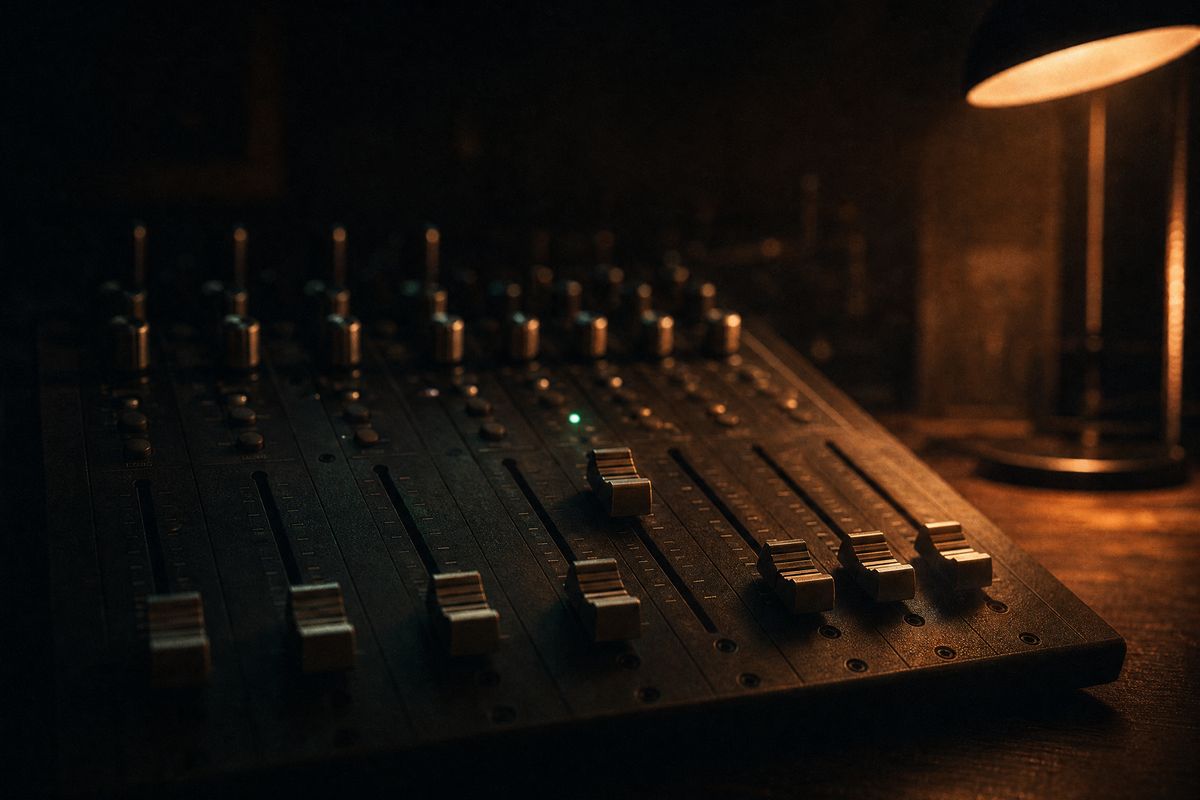
Pass one uses one pair of closed-back studio headphones, driven from a small interface rather than the console's controller output, at a level we mark on the desk and do not touch. Pass two uses a 55-inch television bought in 2021, unmodified, with its own speakers and its default sound profile — deliberately not the best television in the office. Pass three uses whichever display the game is already on, with system volume at zero and captions enabled.
We do not use spatial audio, virtual surround, or any post-processing in any pass. If a game requires those things to be legible, that is itself a finding, and it goes in the reading.
Standing rules
What we refuse to do
- We do not publish a reading with fewer than three completed passes, even if the game is short.
- We do not accept review copies, early access codes, or travel. Every game on this site was bought at retail price by one of the three of us.
- We do not carry advertising, affiliate links, or sponsored placements, and there is no third-party code on this site.
- We do not give numeric scores, star ratings, or awards, and we will not aggregate the three findings into one figure on request.
- We do not quietly rewrite published readings. Corrections are appended and dated, and the original sentence stays visible.
Questions
Things people ask us
It overlaps with one, and we are glad of that, but it is not the same thing. A proper accessibility review would test controller remapping, colour contrast, text scaling, difficulty options and much more. The muted pass asks one question only: how much of this game lives in its audio? The answer happens to be useful to players who are deaf or hard of hearing, to people who play with a sleeping child in the next room, and to anyone whose television is worse than they admit.
Because a score answers the wrong question. A game can have extraordinary sound design that fails completely through television speakers, and a modest one that survives anything. Those are different pieces of advice, and a single figure cannot hold both. The three findings tell you which room the game belongs in, which is the thing we would actually want to know before spending an evening.
At least ten hours in total, with a minimum of three hours in each pass, and for a long role-playing game it can run past forty. We print the hours logged at the top of every reading so you can weigh the opinion accordingly. If we cannot reach ten hours — because the game is broken, or because we lost interest and want to say so honestly — we set it aside rather than publish a partial reading.
Partly. We nominate two or three sections as fixed comparison points and play them identically in all three passes — usually an early quiet scene, one busy combat or crisis, and one dialogue-heavy stretch. The rest of each pass is played normally, because a method that only ever measures the same ten minutes will tell you nothing about how a game behaves over an evening.
Yes to both, through write in. Suggestions go on a list that the three of us work through in the order it arrives, with no way to pay for a place on it. We will redo a reading if a game receives a substantial audio patch, and when we do, both readings stay on the site with their dates.